WACO COUNTRY CLUB, CAMERON PARK CLUBHOUSE AND STURGIS ROAD

WACO COUNTRY CLUB, CAMERON PARK CLUBHOUSE AND STURGIS ROAD

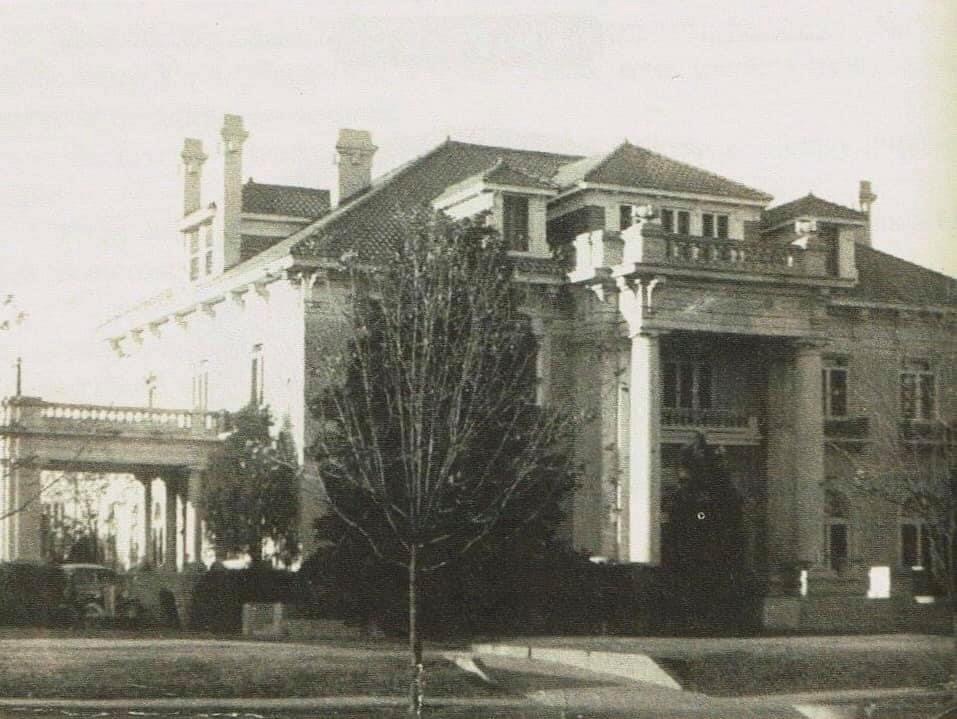
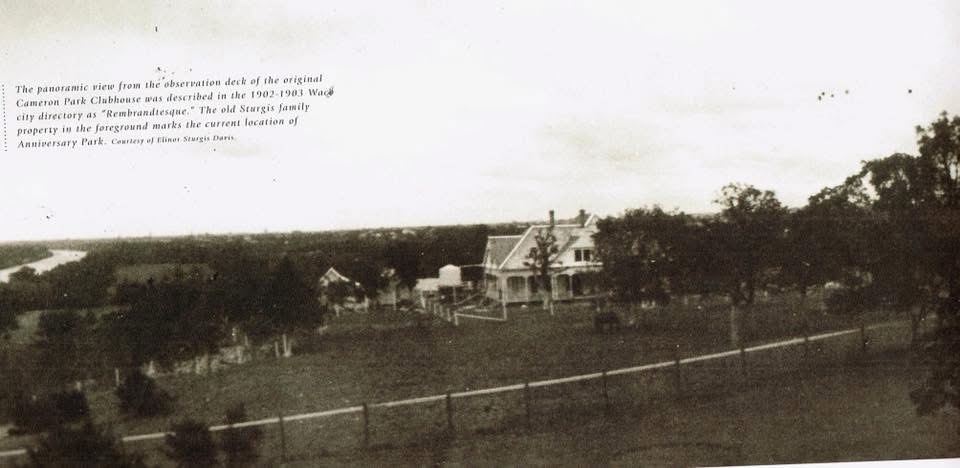
What we know as the “Cameron Park Clubhouse” was built in 1902 as a private country club and was known as “Waco Country Club”. The Cameron Family added it to Cameron Park in 1920. In what is now “Anniversary Park” there once stood a beautiful home that belonged to the Sturgis family. Lindsey Hollow Road was the only road that led to the Country Club, and the city needed a more direct road. Mr. Sturgis donated access to the city for what became “Sturgis Road”. Then, he sold his land to the city a few years later.
All of the photos in the post are from the book “William Cameron Park: A Centennial History:1910-2010” by Mark E. Firmin. Additional photos are in the comments.

Virginia Plunkett does a beautiful job of telling us the rest of the story:

“Sturgis Road is Not Named for Francis?”
From the book “Around Again” by Virginia Plunkett

Seeing the street sign, STURGIS ROAD, and knowing the many things Francis Sturgis does for Waco, I thought for sure Sturgis Road in Cameron Park was named for her.

But I was close! It seems that in the 1900s, James H. and Lula Carroll Sturgis lived in a house on property near the Cameron Park Clubhouse, and it was in this house that James H. Sturgis, Jr., Carrol Sturgis, and Anna Sturgis were born.

Lindsey Hollow was the only road leading to the clubhouse, and that was to the back of it. The city needed a road that led straight up to the front of the clubhouse, and asked James Sturgis to sell the right-of-way.

The kindly gentleman gave the right-of-way, accepting no money, and in turn the city officials named it STURGIS ROAD. Later, when Cameron Park was being developed, the city officials went back to Sturgis with an offer to buy the rest of his property and his house.

Two years later, Sturgis did sell his house and land to the city and moved his family to a Victorian style home he had bought at 1316 Washington. James N. Harris had built the home in 1887 for his daughter Lola and her husband, Edward H. Hardin.

During the next several years, James Sturgis. Jr. had moved to Lexington, Missouri, Anna had married Harry Jeanes, and Carrol had married Frances Burnett of Murfreesboro, Tennessee.

Carroll and Frances continued to live in the lovely red brick, black wrought-iron trim house on Washington.

Driving down Washington, when you saw Carroll planting yellow daffodils, you knew it must be Spring. Those beautiful yellow flowers up the walkway and around the front of house were a treat for the passers-by for many years, until Carroll and Frances sold the house to a group of attorneys and bought a charming little “one-story” house in Castle Heights. And, if driving by, I bet you’ll know the house by the lovely seasonal flowers Carroll has planted up the front walk and in the garden spots of the house.

—————

George Randall Scott is a fifth-generation Wacoan who currently lives in Bryan-College Station, Texas. He is the administrator of a number Waco history groups and pages on Facebook, including “Waco, Texas History in Pictures.”

TEXAS COTTON PALACE CORNERSTONE

TEXAS COTTON PALACE CORNERSTONE

This cornerstone was originally on the Main Building at The Texas Cotton Palace, but was moved to Cameron Park, shown here. This photo is from Lavonia Jenkins Barnes’ 1964 book “The Texas Cotton Palace.” The caption under the photo says, “Albert T. Clifton, President of the Cotton Palace in 1910-1911, who had the cornerstone moved and erected in Cameron Park.” This cornerstone is now a part of the collection at The Taylor Museum of Waco and McLennan County History.

The Old Library

When the HEB Building was built at 18th and Austin in 1951, the Waco Public Library was in the old Cameron home across Austin Avenue. It was like this until the Cameron Home was torn down in 1960 for the construction of the current Waco- McLennan County Library, which opened in 1962.

The photo of HEB was contributed by Myron Patrick King and the photo of the Cameron House is from The Texas Collection, Baylor University.

Fred Gildersleeve

We owe a great debt of gratitude to Fred Gildersleeve, who was one of the greatest “Waco, Texas History in Pictures” photographers ever!

This 1944 photo is from “A Pictorial History of Waco” (1964) by Roger N. Conger. The photo is a part of the Gildersleeve-Conger Collection at The Texas Collection, Baylor University.

Memorial Day: Remembering Wacoans Who Gave All

Doris “Dorie” Miller (October 12, 1919 – November 24, 1943) was an American Messman Third Class in the United States Navy. During the attack on Pearl Harbor on December 7, 1941 Miller manned anti-aircraft guns, (despite having no formal training in their use), and attended to the wounded. For his actions, he was recognized by the Navy and given several medals. Nearly two years after Pearl Harbor, he was killed in action when Liscome Bay was sunk by a Japanese submarine during the Battle of Makin. (Wikipedia)

Photo of Doris Miller from The Texas Collection, Baylor University.

CHRISTMAS IN WACO

Austin Avenue at Christmas, 1955

“There’s No Business Like Show Business”, which is showing at The WACO Theater,was released January 6, 1955.

This photo, which is a part of The Texas Collection at Baylor University, was originally black and white. Color has been added by our friend Ron Hatchett. The photographer is not known to us.

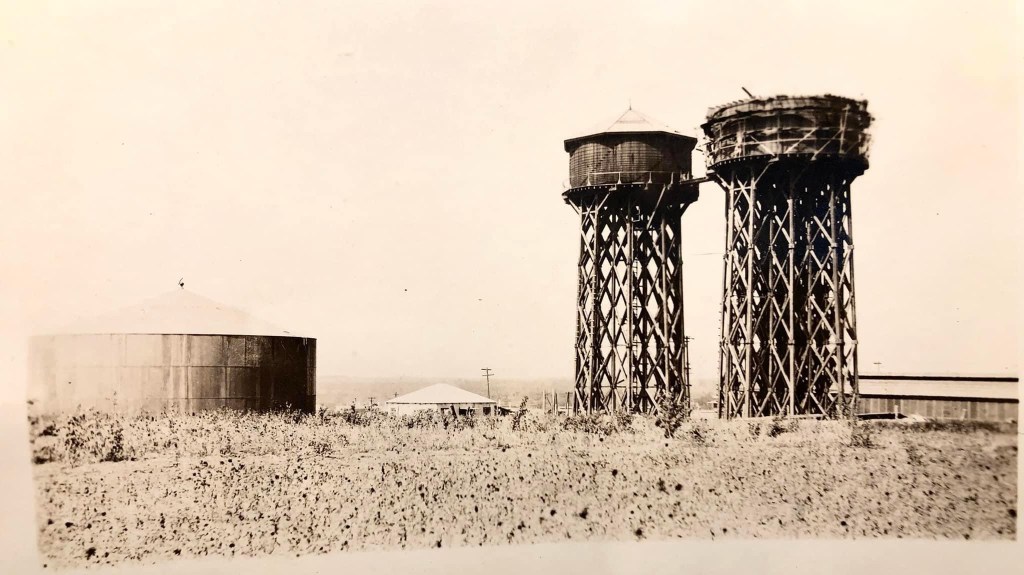
CAMP MACARTHUR’S TWIN WATER TOWERS

Two water towers were constructed in 1917 that supplied water for all of Camp MacArthur. These water towers were located at what is now the northeast corner of North 32nd Street and Herring Avenue. Aerial views taken of The Base Hospital were all either taken from the twin water towers, or the unfinished Hillcrest Baptist Hospital.

-George Randall Scott for Waco History in Pictures, Bryan-College Station, Texas.

This photo was taken by an unidentified soldier who wrote: “These are the water tanks that supply the whole camp. I had to guard them once when I was on guard. The house in the center is the pumping station and we sleep in it when we are on guard there. Camp MacArthur-Waco Texas.”
This photo is from our collection.
This photo was taken by an unidentified soldier who wrote: “The water tanks under construction at Camp MacArthur-Waco,Texas.”
This photo is from our collection.
This photo was taken by an unidentified soldier who wrote: “Base Hospital at Camp MacArthur-Waco, Texas. This is taken from the top of the water tank.”
This photo is from our collection.
This photo was taken by the same unidentified soldier who provided pictures of the construction of the water towers. He wrote: “Breaking camp in Section F at Camp MacArthur-Waco, Texas.”
This photo is from our collection.
Base Hospital
Camp MacArthur Waco, Texas
This photo was taken from one of the twin water towers on the northwest corner of Herring Avenue and North 32nd, by Fred Gildersleeve, and is part of the Gildersleeve-Conger Collection at The Texas Collection, Baylor University.

JAKE JACOBS’ PHOTO COLLECTION

Gudmund “Jake” Jacobs of Detroit, Michigan was sent to Camp MacArthur in Waco, Texas to train for service in World War I. While he was there, he purchased photo postcards and mailed them to Miss Mable Thurston in Detroit, Michigan, whom he later married. After Waco, the war took Jake to France where he served and carried wounded soldiers off the battlefields on stretchers. Jake’s great-niece Averill Tune sent this collection to us, and we gratefully received them. Many of these photo postcards are familiar to us, but these are in pristine condition.

Gudmund “Jake” Jacobs Memorial:
https://www.findagrave.com/memorial/188383083/gudmund-jacobs

Mable Thurston Jacobs Memorial:
https://www.findagrave.com/memorial/188383093/mabel-jacobs

George Randall Scott
Bryan- College Station, Texas
November 6, 2023

Jake Jacobs and four friends. Location not known.
Jake in Sauvignon, France. April 20, 1919.
Company Street, Camp MacArthur, Waco, Texas
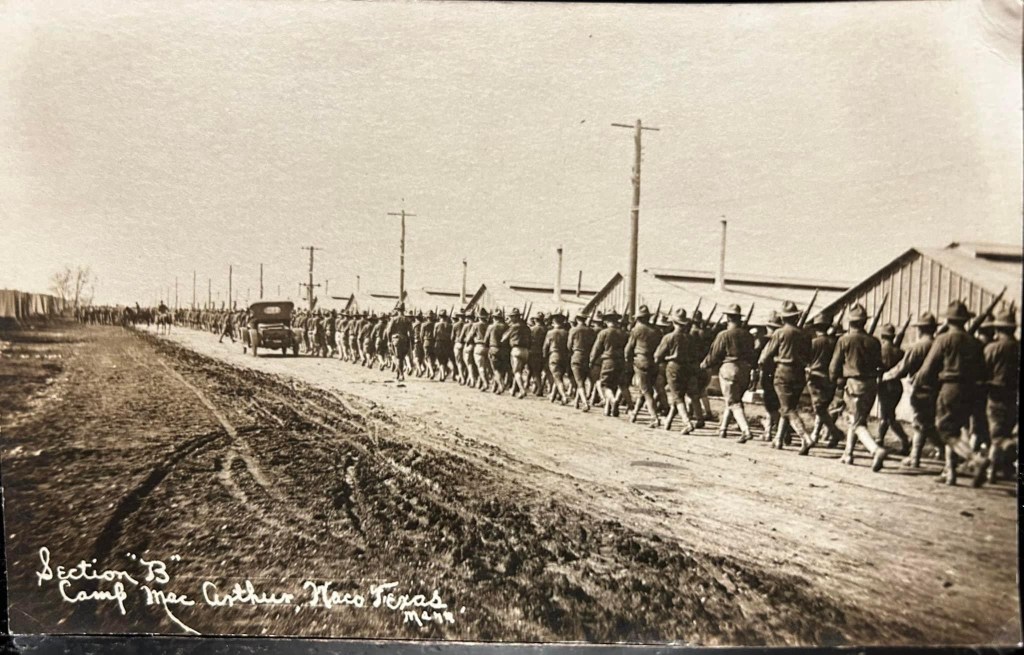
Section “B” Camp MacArthur, Waco, Texas. Photo by F. Mann.
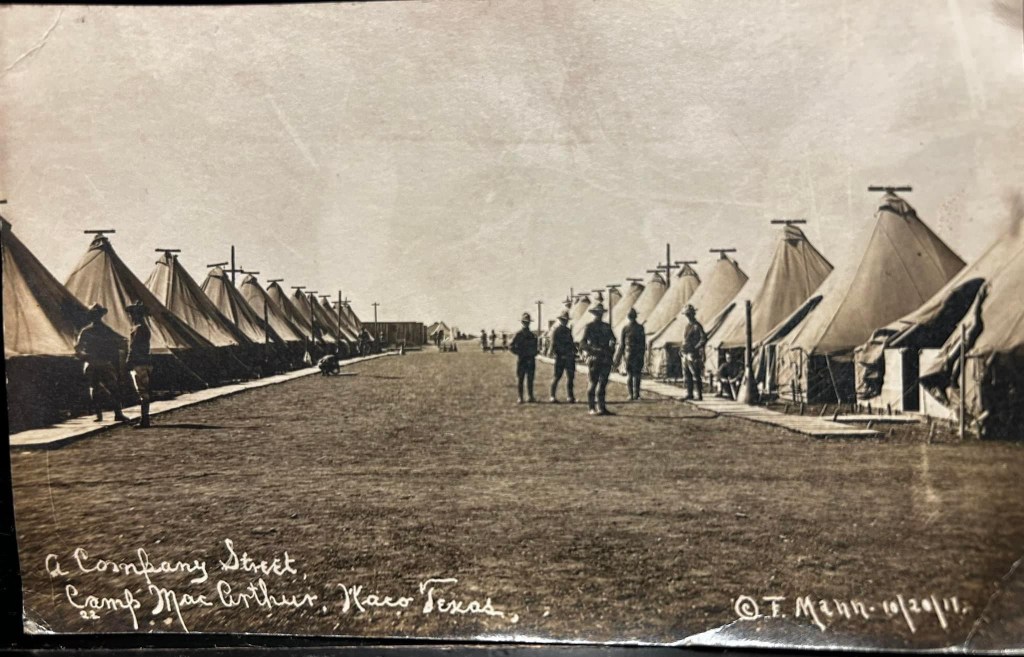
A Company Street, Camp MacArthur, Waco, Texas.
Headquarters, Camp MacArthur, Waco, Texas. This is the northwest corner of N. 19th Street and Park Lake Drive.
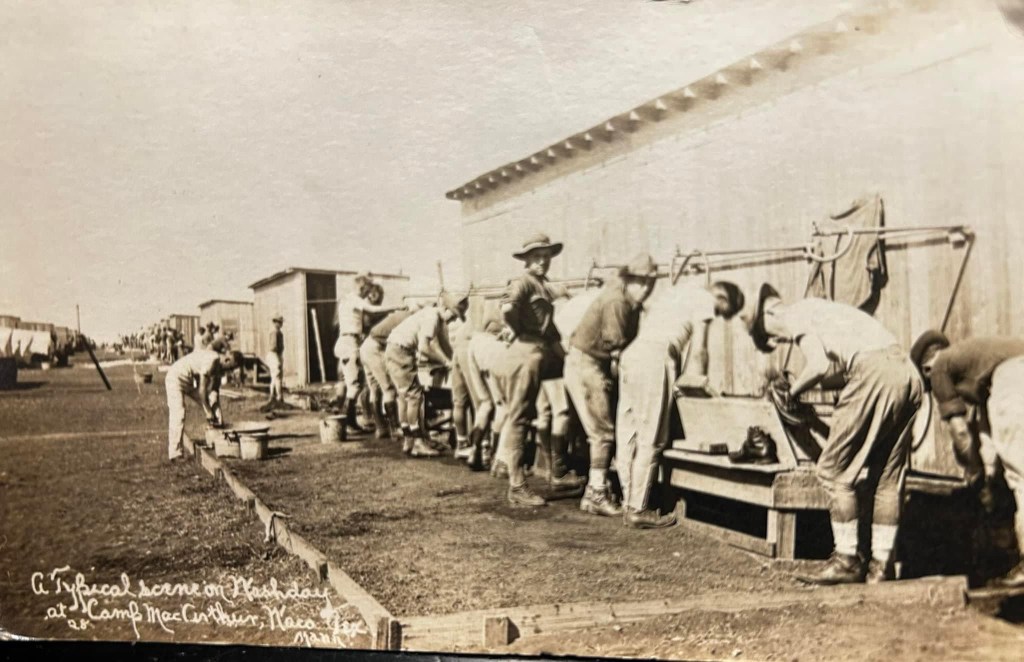
A typical Scene on Washday at Camp MacArthur, Waco, Texas.
Photo by F. Mann.
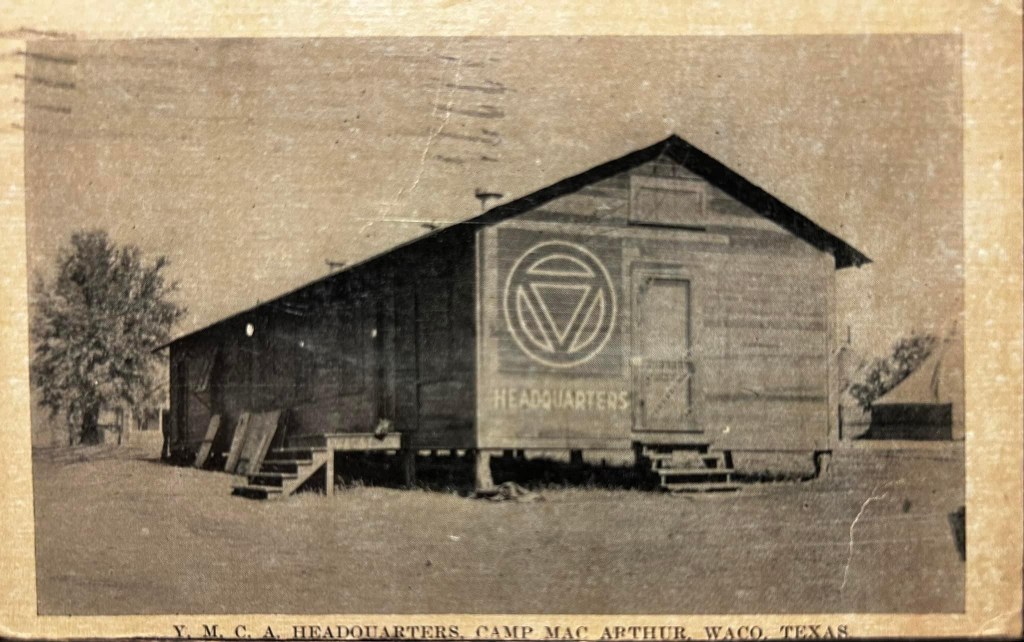
Y.M.C.A Headquarters, Camp MacArthur, Waco,Texas.
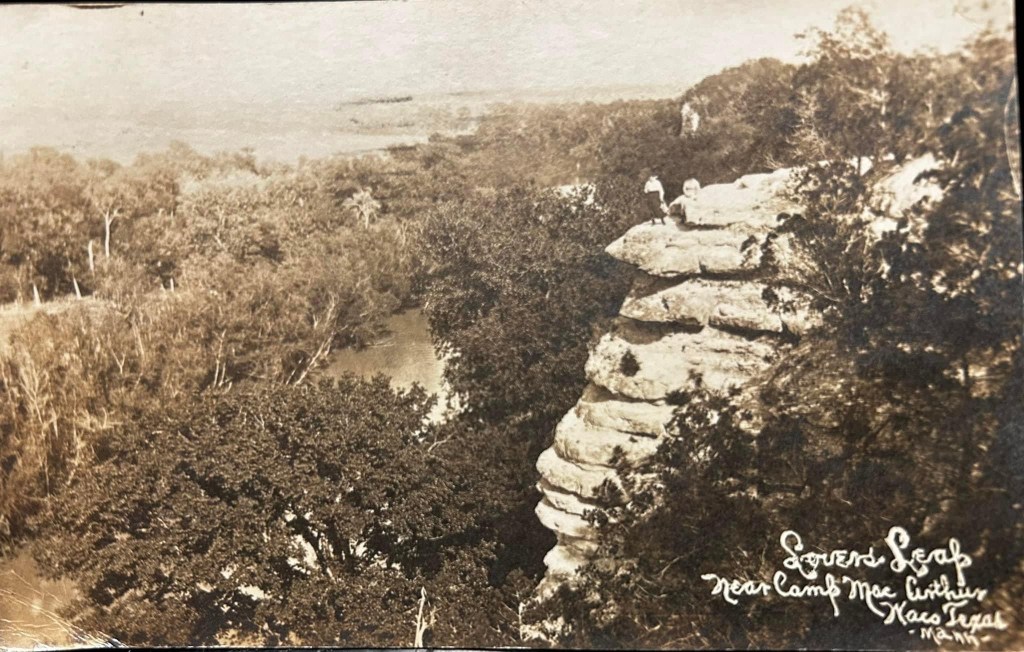
Lovers Leap Near Camp MacArthur, Waco, Texas.
Photo by F.Mann.
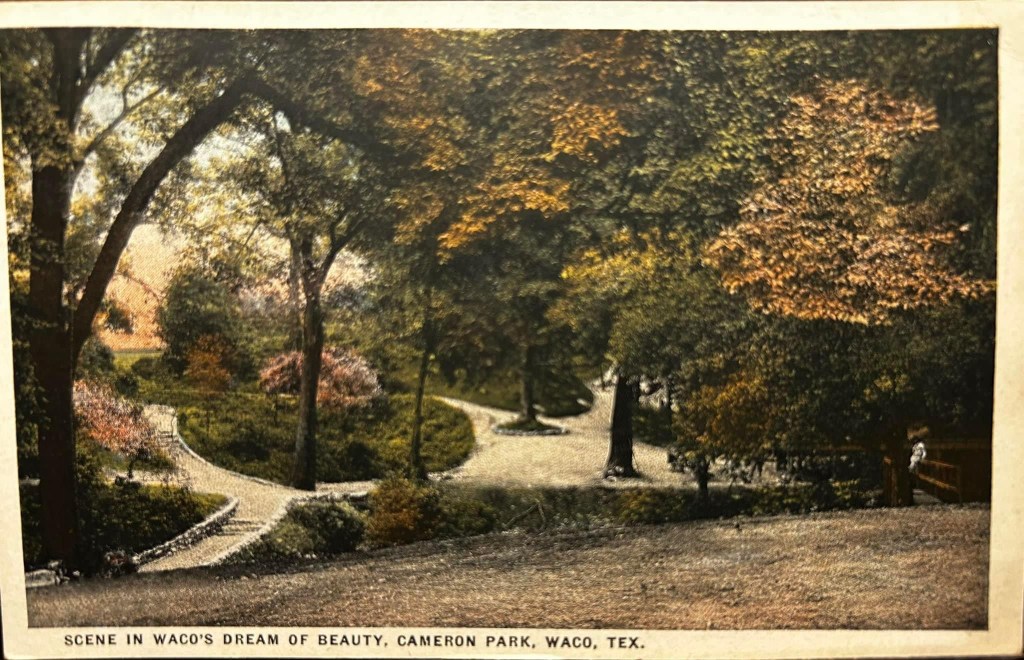
Scene in Waco’s Dream of Beauty, Cameron park, Waco, Texas.
Humorous postcard.
In a Practice Trench. Not at Camp MacArthur.
In the Trenches. Not at Waco.
This newspaper clipping from The Detroit Free Press, Sunday, July 10, 1921 was contributed by Ron Cook.

The Waco Suspension Bridge

THE WACO SUSPENSION BRIDGE

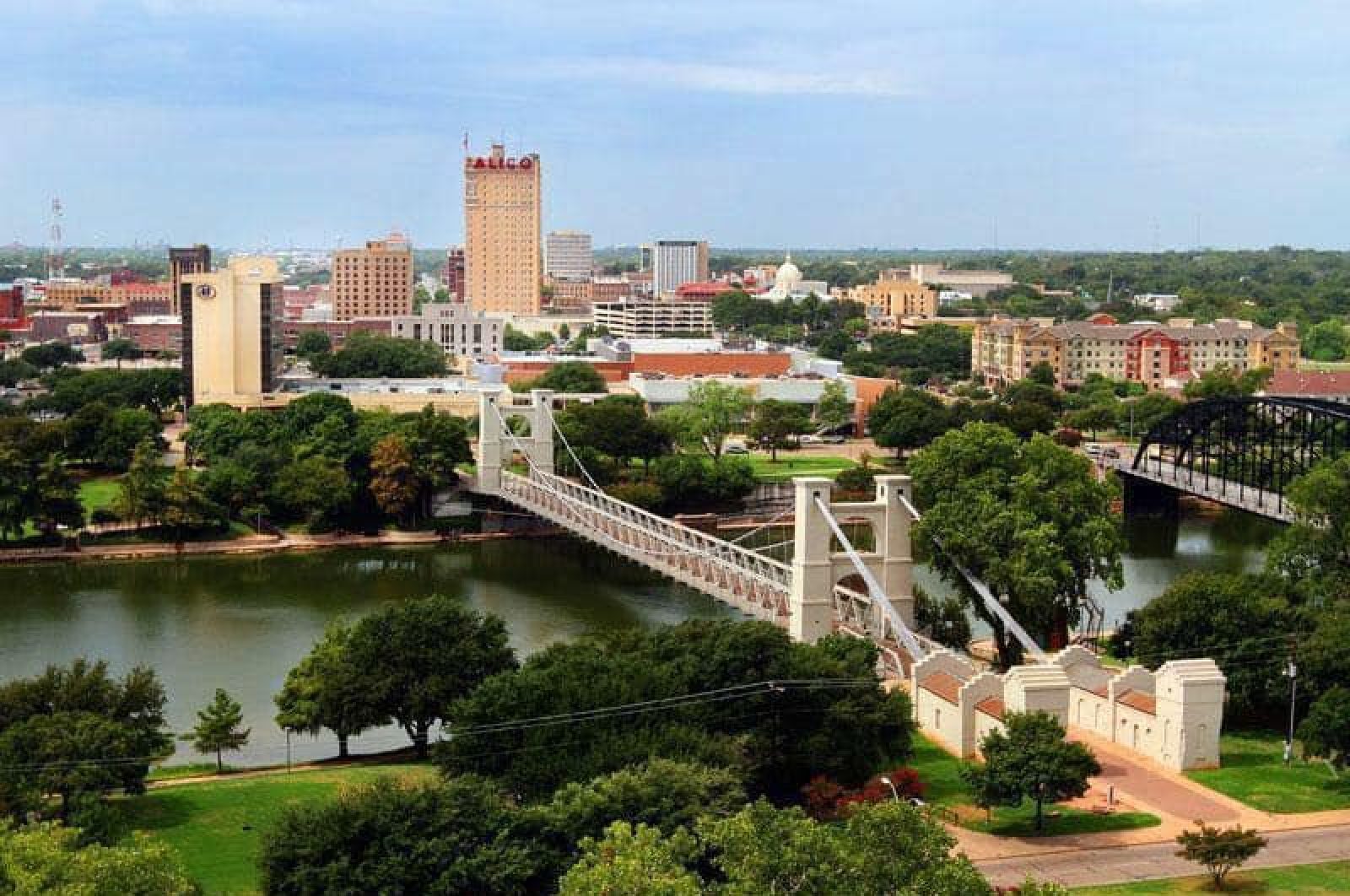
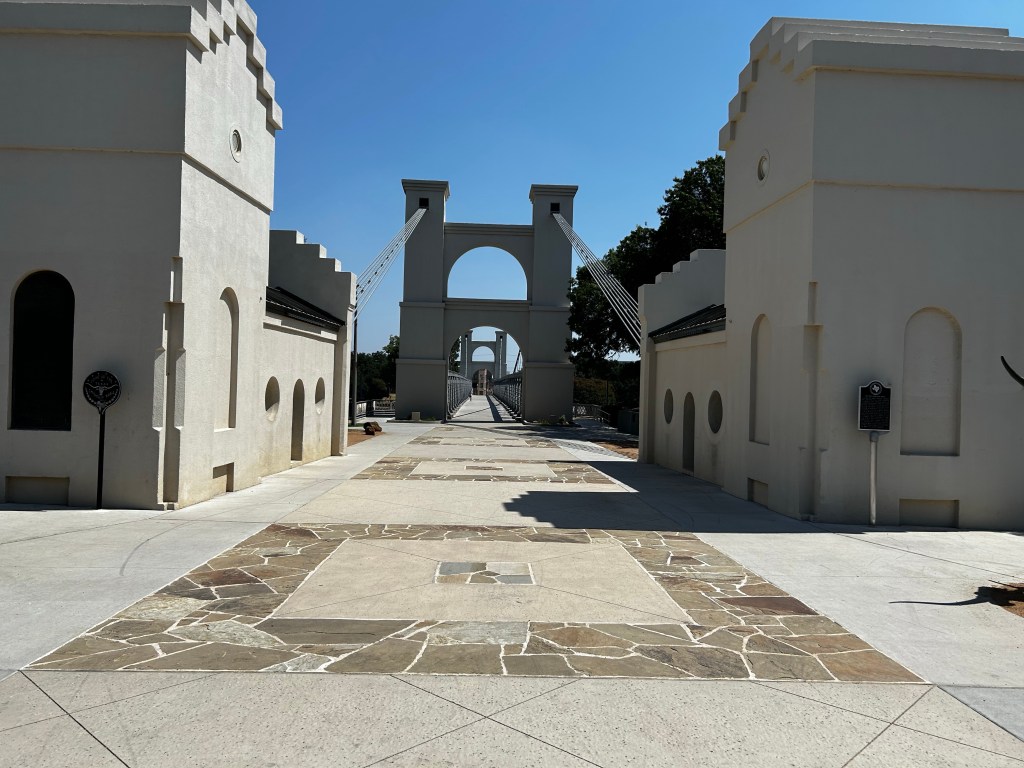
The Waco Suspension Bridge was the first bridge to cross the Brazos River. The Waco Bridge Company was formed in 1866 and hired architect Thomas M. Griffith to design the bridge. Construction began in 1866. Constructed by John H. Roebling, the main suspension of the single-span Suspension Bridge is 475 feet. The Towers and Bridge contain 3 million bricks, all made in Waco. When it opened on January 7, 1870, it was a toll bridge. It was purchased by McLennan County in 1889 for $75,000 and sold to the city of Waco for $1. It knew pedestrian, cattle, and horse and buggy traffic, then later automobile traffic. It was added to the National Register of Historic Places in 1970, and today the well-loved bridge serves as a pedestrian bridge and tourist attraction.

Photo by George Randall Scott, 2023.