The 114 people who died in the 1953 Waco Tornado are remembered on the Waco Tornado Memorial at Fourth and Austin. The memorial was given to the City of Waco by the Phipps Family.
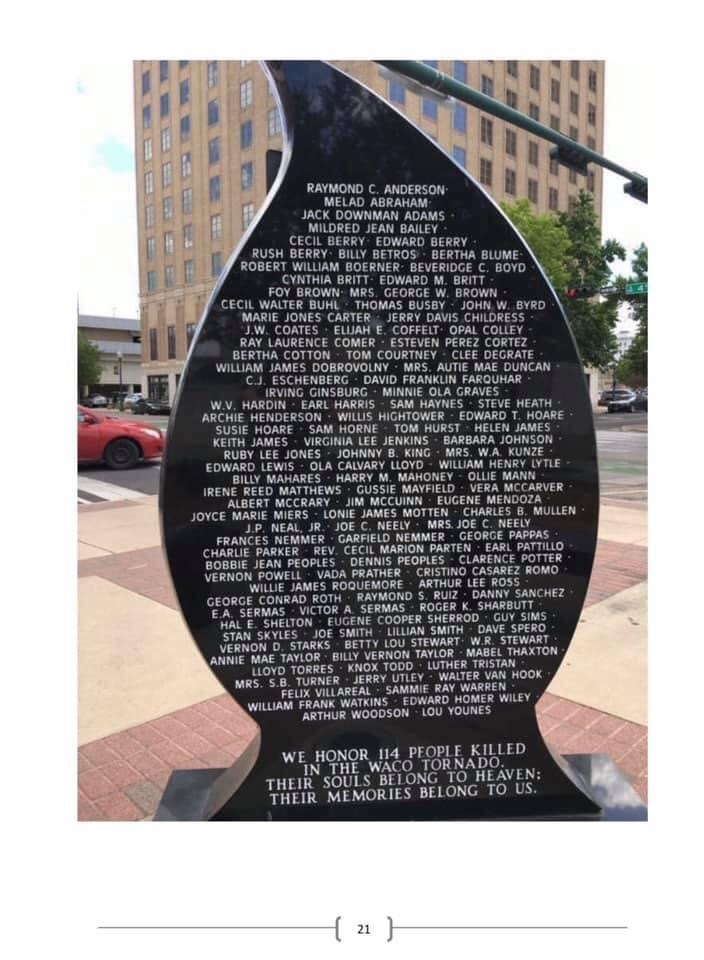

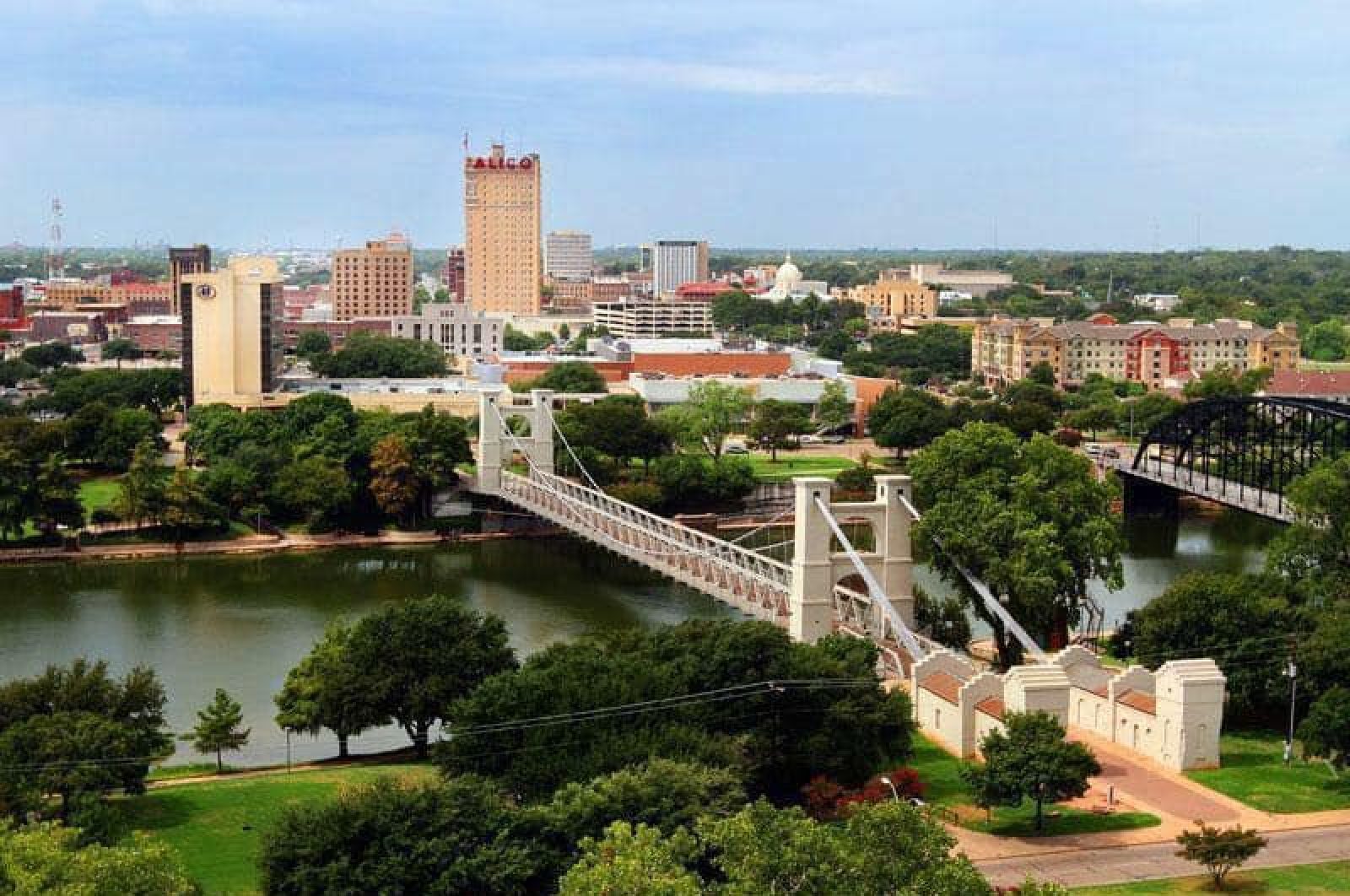
The 114 people who died in the 1953 Waco Tornado are remembered on the Waco Tornado Memorial at Fourth and Austin. The memorial was given to the City of Waco by the Phipps Family.
The November edition of “Waco, Texas History in Pictures Magazine” featured the four McLennan County Courthouses and the historical Waco paintings by Ruth McKinney Smith. You can read it on our website at no cost. Go to http://www.wacotexashistoryinpictures.com and select “Magazine” from the menu.

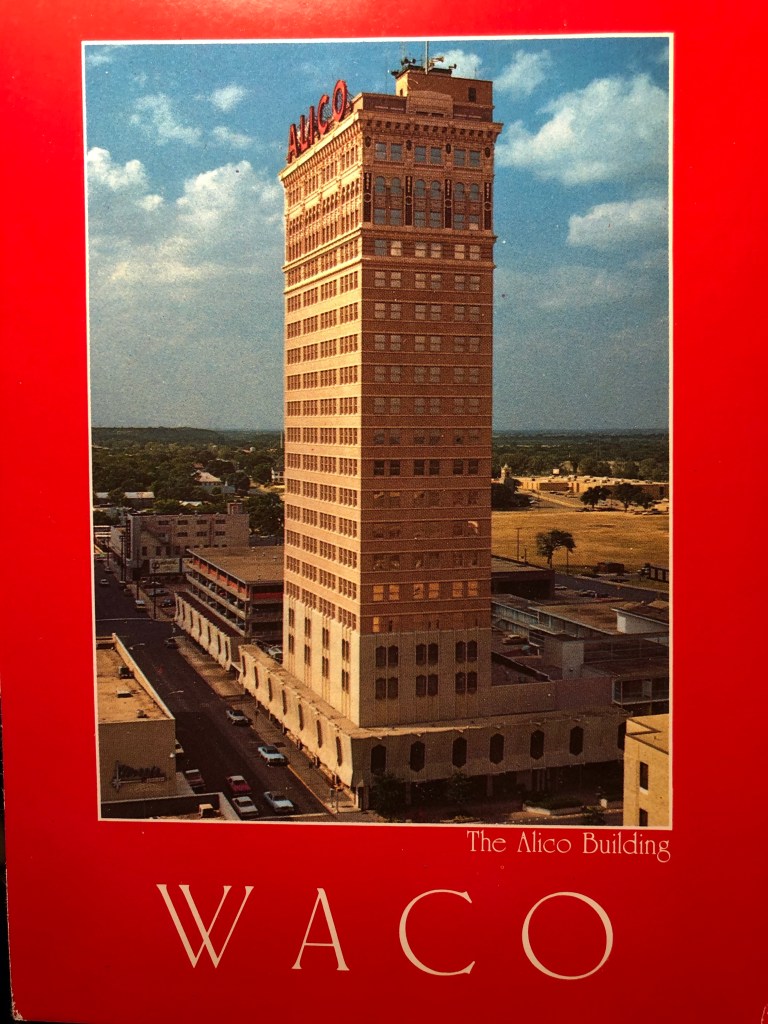
THE ALICO BUILDING
Photo by John R. Gorham
From the reverse side of postcard:
“Built in 1911, it is 22 stories tall and when built it was the tallest building west of the Mississippi River. During a devastating tornado in 1952* which virtually destroyed downtown Waco, the Alico Building withstood and sustained no damage.”
*The postcard incorrectly states that the Waco tornado was 1952. It was May 11, 1953.
This postcard is from our personal collection.
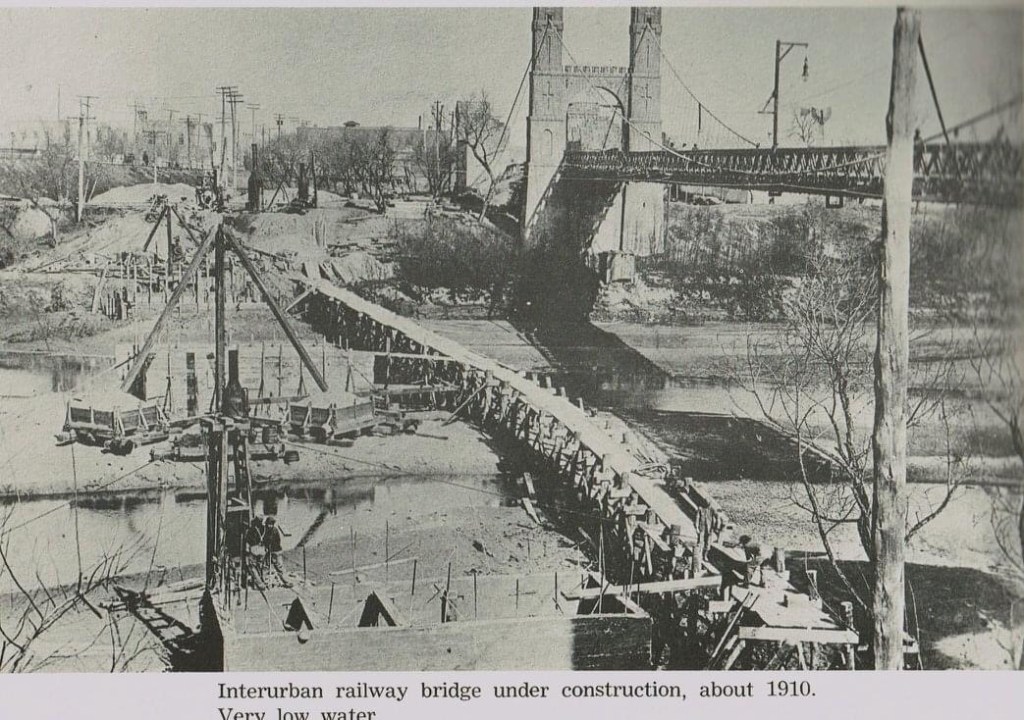
Flooding of the Brazos affected East Waco much more than downtown Waco. 1913. The Suspension Bridge (1870), and the recently completed Interurban Bridge (1913).
Photo by Fred Gildersleeve. From the Gildersleeve-Conger Collection, The Texas Collection, Baylor University.
From the book “A Pictorial History of Waco” (1964) By Roger Conger.

UNCOVERED
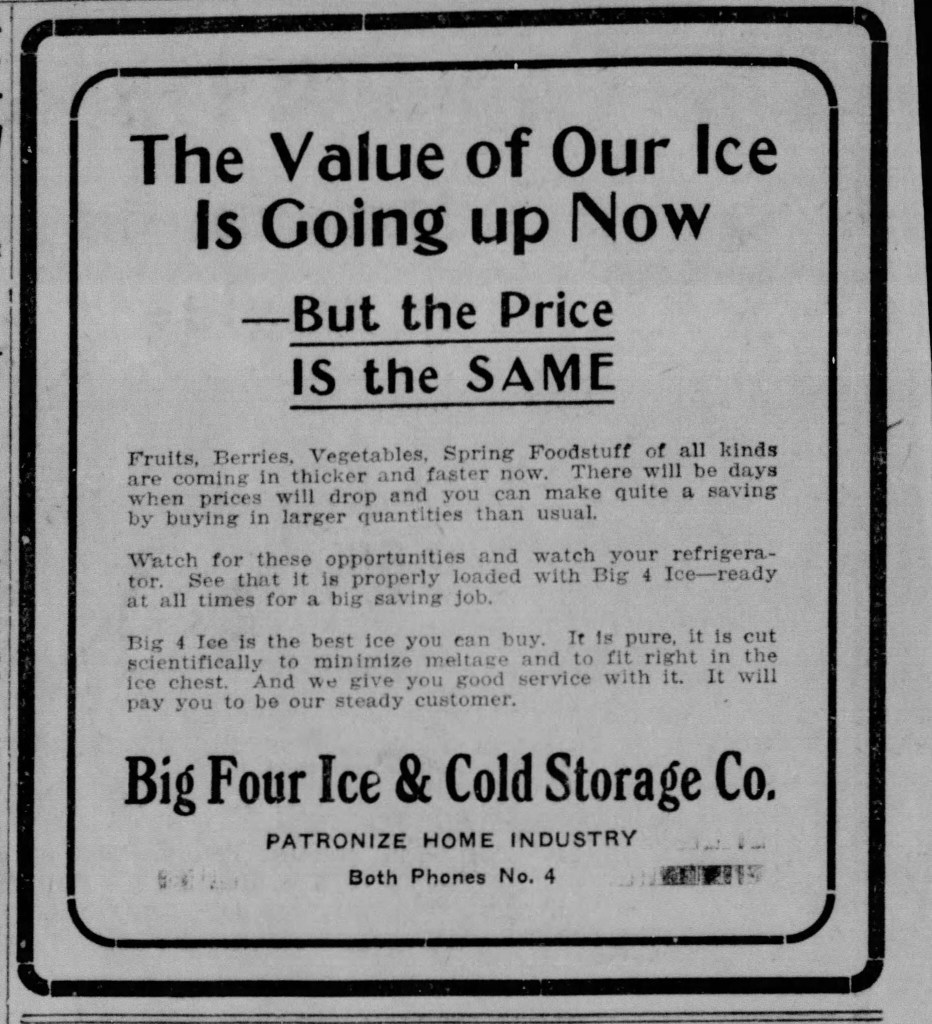
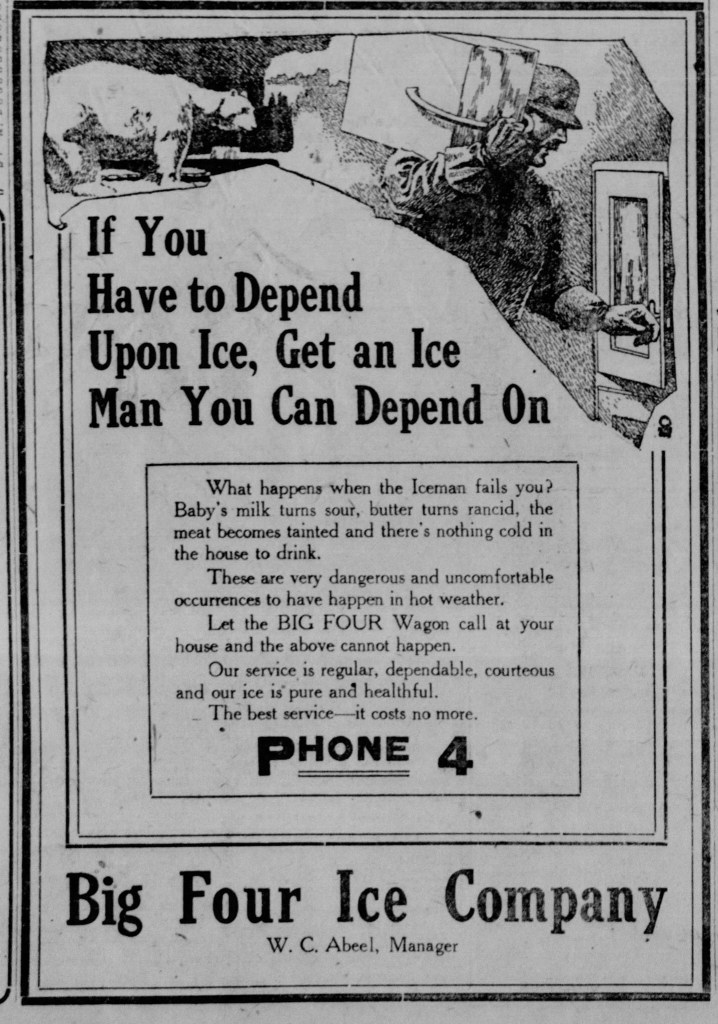
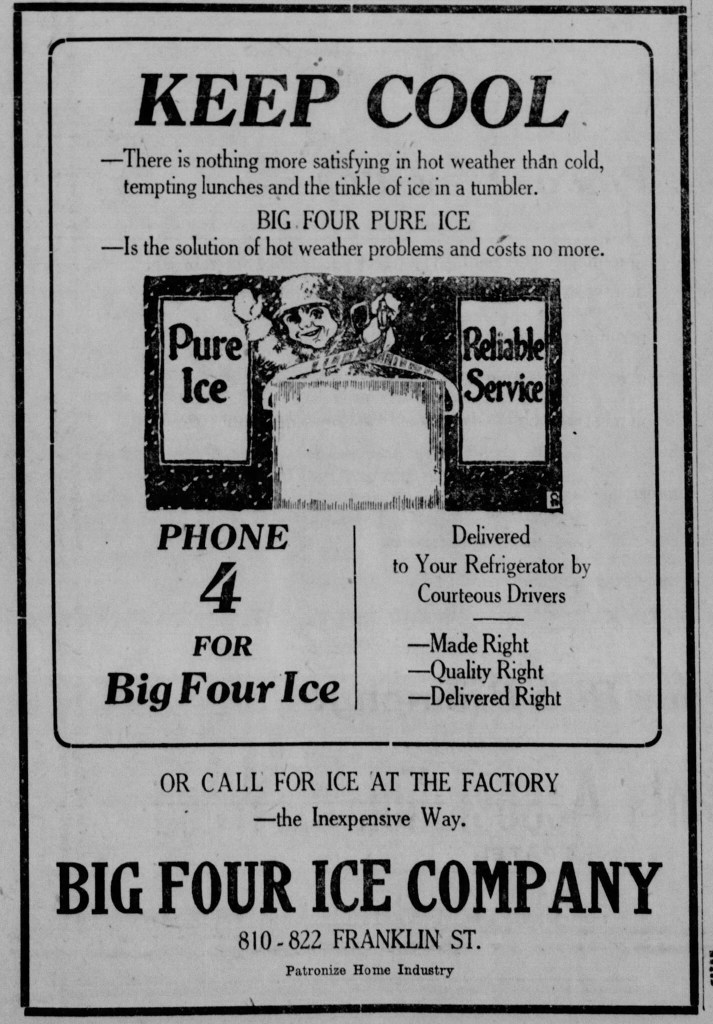
Avery Von Blon writes that he wonders how many Wacoans have spotted the old Big 4 Ice Co. emblem recently exposed on the little building at Twelfth and Columbus that used to be an “ice house”.
“It will take some of the old hats of Waco to recall this or the chore of buying ice here and taking it home on the bumper of one’s car and carrying it into the house to place in the ice box to keep things cool.”
“How many times did one forget to empty the pan under the ice box and let the water run over?” Von Blon asked.
It’s a safe guess there are quite a few out there who remember Big 4 Ice Co., but even some of those might have forgotten how handily a nickel block of ice would fit on the bumpers of the cars of yesteryear.
The Waco Tribune Herald, October 12, 1975.
Article contributed by Mike Braun and transcribed by Randall Scott.
(NOTE: Big 4 Ice Company was located on the southwest corner of 8th and Franklin, 203-225 South 8th, where M. B. Ise Cream Company was earlier, and where the new Post Office would later be built.)

The Mouth of the Bosque
Cameron Park
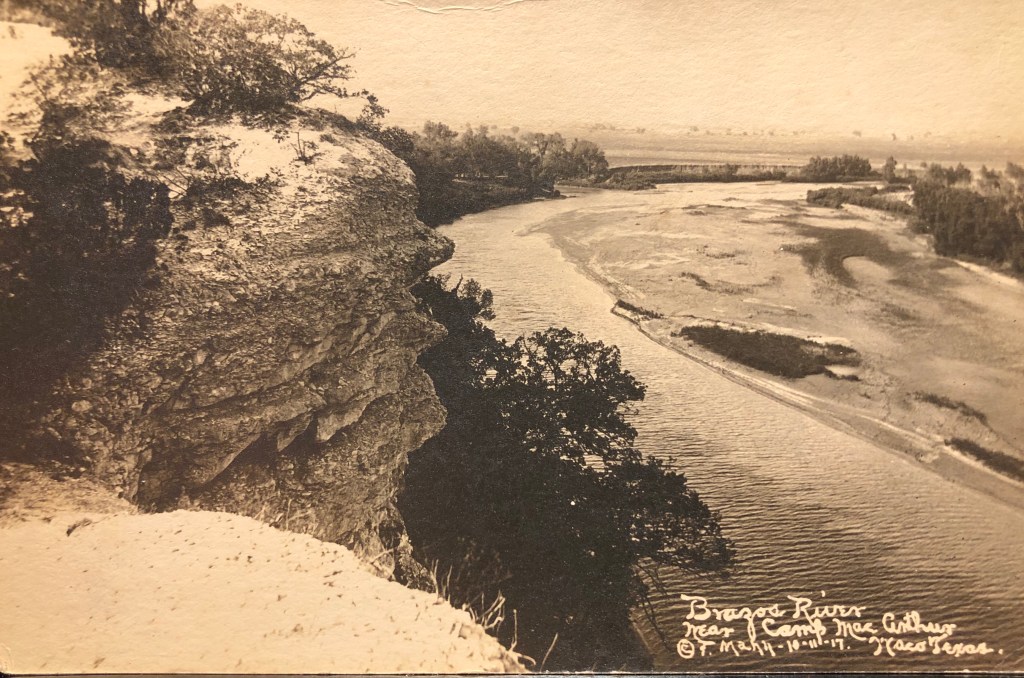
October 11, 1917
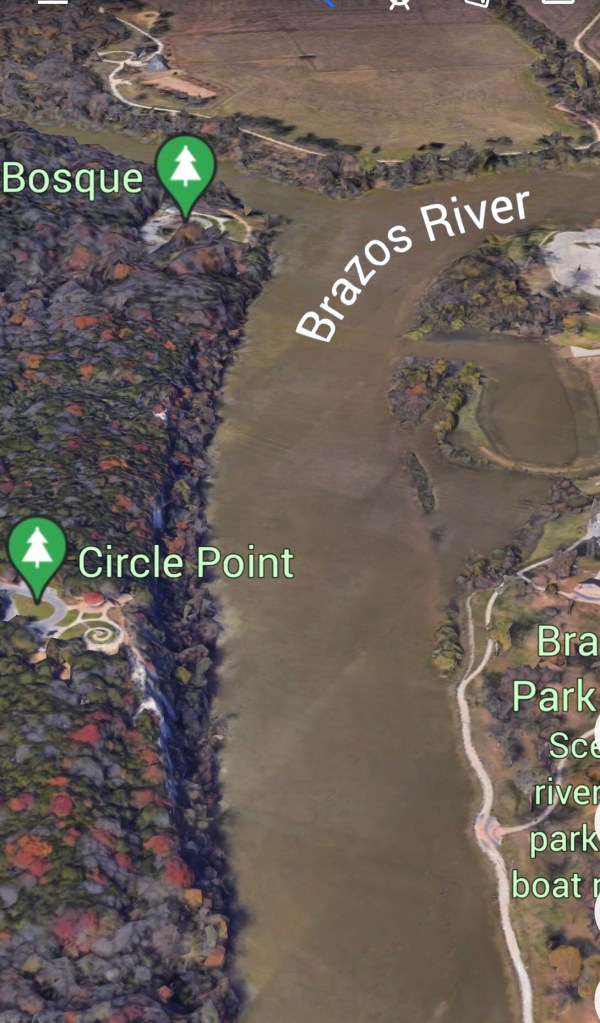
We recently acquired this post card photo that I had never seen. It was taken by T. Mann, a photographer who seems to have been associated with WWI Camp MacArthur (1917-19) in North Waco. The cliff is what we now know as “Circle Point” and the Bosque River, which has just flowed past Lovers Leap, is now joining the Brazos River, where it will continue the journey south through Waco and beyond. Where the Bosque River meets the Brazos River is called the “Mouth of the Bosque”. The area at the top of the photo is Steinbeck Bend. And if you’re new to Waco, “Bosque” is pronounced “Bos-Kee”. 😊
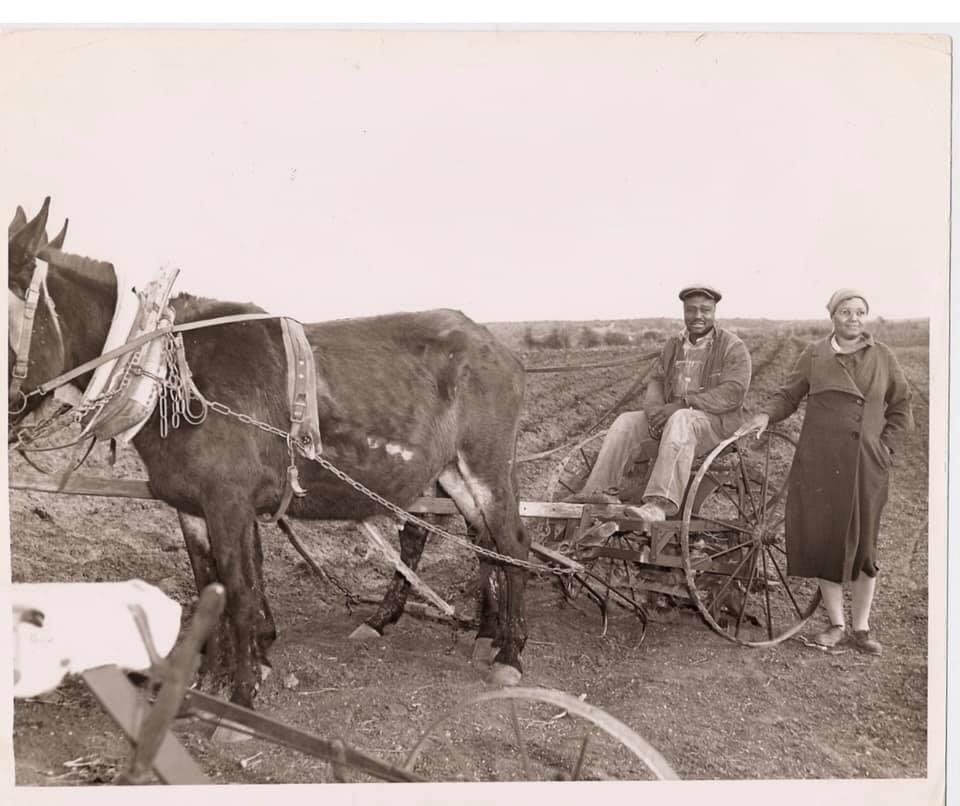
Connery and Henrietta Miller, parents of Doris Miller. He grew up in the Kimmonsville community, close to Speegleville. When the new dam was built in 1958-64, the Kimmonsville community was taken in by the new lake. This photo is very likely to be in Kimmonsville.
FROM READERS:
Interurban Bridge Missed By Wacoan
To the Editor:
I miss the old Interurban Bridge recently razed. To the aesthetically minded, and those who wish to set the old Suspension Bridge off in an environment where it can be viewed without encumbrance, I must surely sound like a nut. I am sure that the only persons who feel as I do about the old interurban bridge are railroad enthusiasts, as I am.
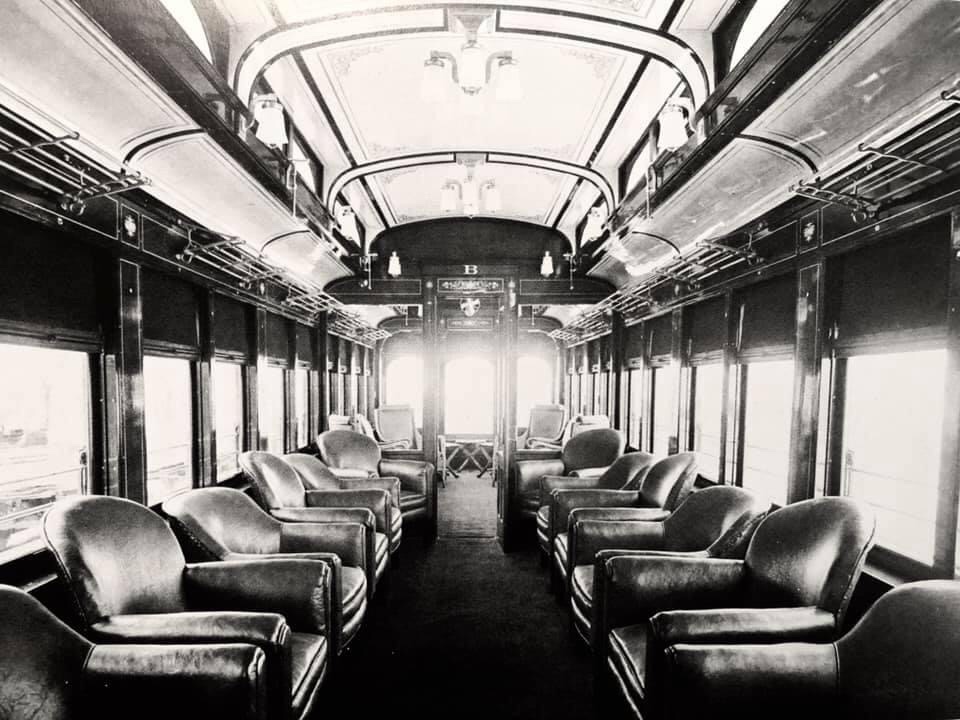
The teenager of today, who has not seen one of the big red cars, scurrying across the landscape carrying happy people, swiftly, safely, frequently and with a dash and elan never before or after achieved, has missed one of the most dramatic sights in the realm of transportation.
Now, so few artifacts of that glamorous era are left, and only an occasional glimpse of an embankment, a bridge abutment, an occasional substation or depot or terminal building are left to remind us of a far-flung transportation system that was born and bred out of necessity and for about 50 years served faithfully its particular mission.
Due to muddy roads, unreliability of early automobiles, and infrequent passenger train schedules, the interurban was born to carry persons swiftly and safely to their destinations.
Basically the interurban connected urban centers of population, but served more the needs of the rural areas, and stops were made almost anywhere in between.
One of the reasons for the success of the Interurban was its swift acceleration, and rapid deceleration. They could go from zero to 50 miles an hour in the the matter of seconds, and could stop within a distance a third of that of a standard passenger train. This meant a faster running time than that of any form of transportation, including the more numerous stops enroute.
The death knell of the interurban came because of better roads, improved automobiles, and buses, and when they did close down, it was strictly because of fiscal reasons, no longer being profitable.
Only one interurban system that started as such is now in existence, as far as I know, and is the Chicago South Shore and South Bend, but it seems to exist now as an electric railroad carrying freight and passengers. Interurbans pretty well covered the entire U.S.A., but the highest concentration of lines was in the Midwest in the states of Illinois, Ohio, and Indiana.
Interurbans per se have gone, but it will be many years before a more useful and gallant system of transportation comes along.
Geoffrey S. Dawson
1207 Ashelman
The Waco Tribune Herald, November 7, 1975
NOTE: Construction of the Interurban Bridge in Waco, which was next to the Suspension Bridge, was completed in 1913. When the Interurban ceased operation on December 31, 1948, a new deck was put on the bridge for automobile traffic. Both the Interurban Bridge and the Suspension Bridge were closed in 1973 when the Franklin Avenue Bridge was opened. In 1974, many considered it an eyesore and city fathers decided to demolish it as a part of preparing the town to celebrate the 1976 Bicentennial. The demolition of the Interurban Bridge, which began July 15, 1974, was seen as the first step in restoring the Suspension Bridge for the Bicentennial. Demolition of the bridge, which started in November, 1974, was completed in September, 1975. Today, all that remain are the concrete pylons rising up out of the Brazos River. (Dates confirmed by historic newspaper articles.-Randall Scott)
This article was written by Geoffrey S. Dawson, contributed by Mike Braun, and transcribed by Randall Scott.



WACO’S INTERURBAN BRIDGE (1913-1975)
Construction of the Interurban Bridge in Waco, which was next to the Suspension Bridge, was completed in 1913. When the Interurban ceased operation on December 31, 1948, a new deck was put on the bridge for automobile traffic. Both the Interurban Bridge and the Suspension Bridge were closed in 1973 when the Franklin Avenue Bridge was opened. In 1974, many considered it an eyesore and The Waco Bicentennial Commission and city fathers decided to demolish it as a part of preparing the town to celebrate the 1976 Bicentennial. The demolition of the Interurban Bridge, which began July 15, 1974, was seen as the first step in restoring the Suspension Bridge for the Bicentennial. Demolition of the bridge, which started in November, 1974, was completed in September, 1975. Today, all that remain are the concrete pylons rising up out of the Brazos River.


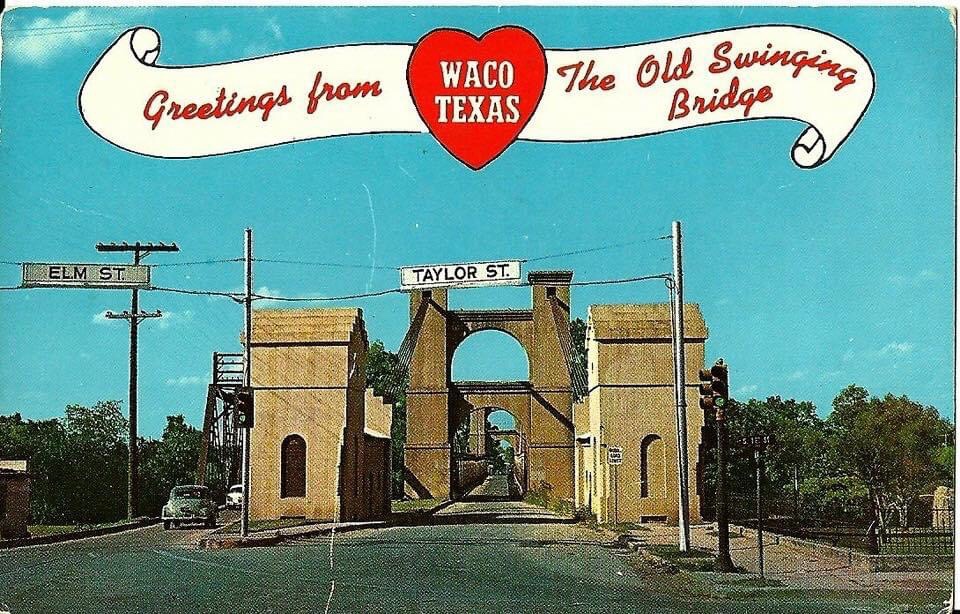

Cross the Brazos at Waco!
Some of the bridges of the Brazos. Upstream and out of view is the Waco Drive Bridge, the Herring Avenue Bridge, the Martin Luther King, Jr. Drive Bridge and the E. Lake Shore Drive Bridge.

 Waco, Texas History in Pictures